
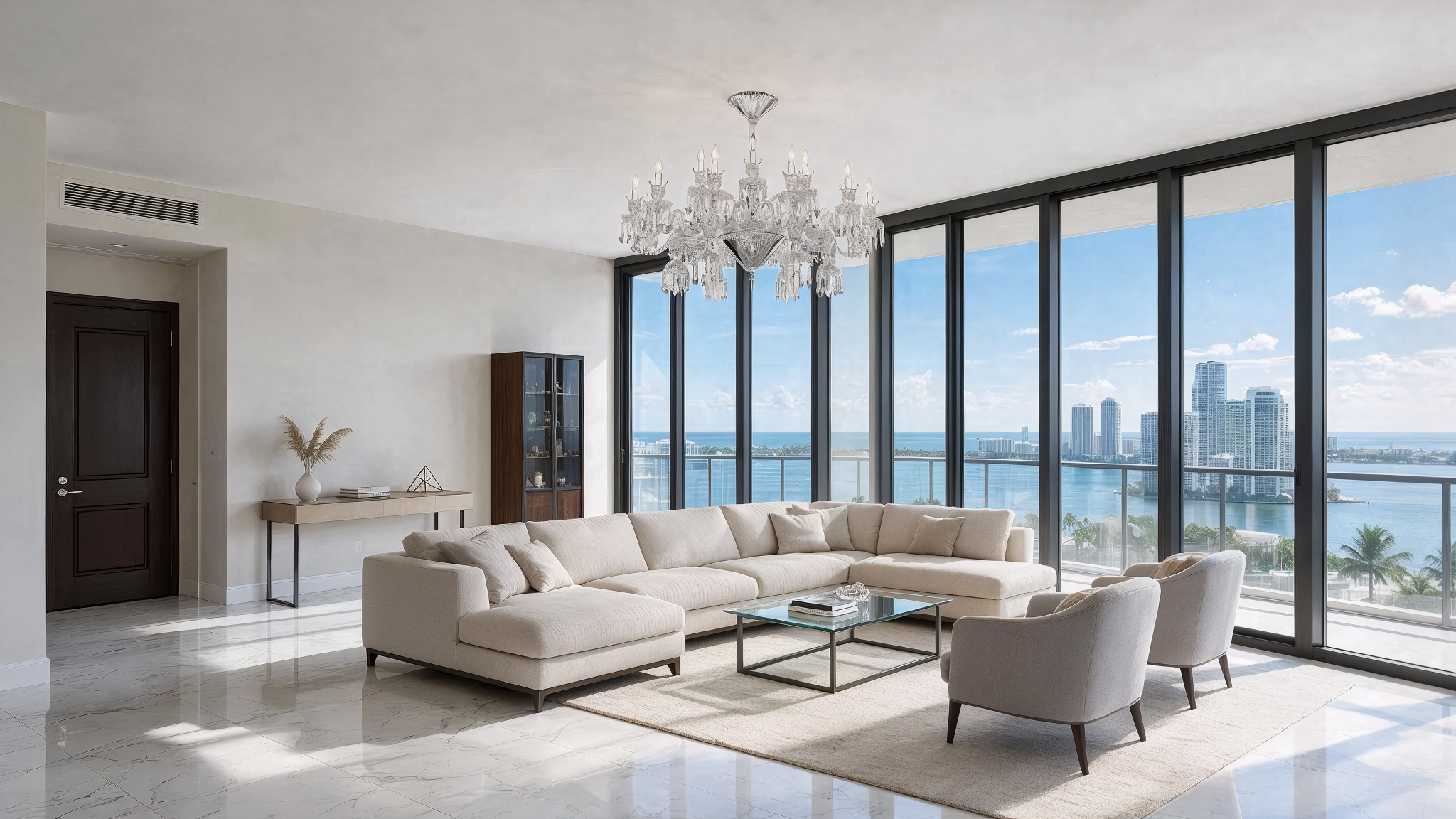
Modern interior design is often associated with clean lines, neutral palettes, smooth surfaces, and restrained decoration. Traditional crystal chandeliers, by contrast, are frequently imagined within ornate interiors filled with elaborate furnishings and decorative details.
Yet these seemingly opposing design philosophies can complement one another remarkably well. In many cases, the introduction of a classical Bohemian crystal chandelier can enhance the very qualities that define a modern space.
Minimalism Is Not the Absence of Character
A modern interior does not have to be an empty, lifeless arrangement of walls and furniture. At its core, minimalism is about using fewer elements to communicate a stronger visual message.
Every material, proportion, and decorative feature serves a purpose. Rather than relying on numerous competing details, the architecture allows individual design elements to carry greater significance.
This is precisely where traditional crystal lighting finds its place.
A classical chandelier introduces intricate craftsmanship and sculptural character without requiring additional furniture, patterns, or decorative accessories. Instead of filling an interior with objects to create interest, one carefully selected lighting fixture can establish an entire room’s visual identity.
The chandelier becomes the focal point, allowing everything surrounding it to remain beautifully understated.
Crystal as a Reflection of Its Surroundings
One of the most distinctive characteristics of clear Bohemian crystal is its ability to interact with the environment without introducing a dominant color of its own.
In traditional interiors, crystal often shares the space with richly colored fabrics, ornate woodwork, decorative wall coverings, and elaborate architectural details. Its brilliance becomes part of an already complex visual composition.
Modern interiors offer an entirely different experience.
Against smooth stone surfaces, neutral walls, polished materials, and uninterrupted architectural lines, transparent crystal takes on the visual character of its surroundings.
Light passes through its precisely shaped surfaces, refracting and reflecting into subtle highlights that respond to the room’s lighting, materials, and viewing angles. With fewer competing colors and textures, these optical effects become more apparent.
The crystal does not need to introduce another color or material to establish its presence. Instead, it reveals new dimensions within the materials already there.
This is what makes classical crystal lighting particularly compelling in contemporary architecture: its complexity is expressed through light rather than visual clutter.
The Dining Room: Where Classical Detail Meets Modern Simplicity
Consider a contemporary dining room with a clean-lined table, understated seating, smooth architectural finishes, and a restrained color palette.
On its own, the space may already be elegant and carefully balanced. Introducing a traditional Bohemian crystal chandelier above the dining table creates an entirely new relationship between the room’s elements.
The chandelier’s intricate arrangement contrasts with the simplicity of the furniture, while its transparent crystal preserves the openness of the interior.
As light travels through the crystal elements, the surrounding surfaces take on additional depth and brilliance. The simplicity of the architecture becomes more pronounced against the chandelier’s detailed construction.
Rather than making the dining room feel more traditional, this contrast can make its modern qualities even more apparent.
The chandelier becomes a refractive lens through which the room’s restrained design is experienced, revealing beauty in surfaces and proportions that might otherwise remain understated.
Different Design Eras, One Visual Language
At Berkana Crystal, we have explored this relationship through residential installations combining classical and contemporary Bohemian crystal lighting.
In a modern private residence in West Kendall, Florida, two individual Star Dust pendants and a Melody 4 chandelier were incorporated alongside a traditional eight-light Magic Swan chandelier.
Although these fixtures represent different design approaches, they share a fundamental relationship through their crystal materials, craftsmanship, and interaction with light.
The contemporary pieces emphasize simplified sculptural forms, while Magic Swan introduces the intricacy and elegance of classical chandelier design.
Together, they demonstrate that stylistic consistency does not require every fixture to belong to the same era. Harmony can emerge through shared materials, thoughtful proportions, and the optical qualities of crystal itself.
The Heart of a Modern Interior
The most successful minimalist spaces are not necessarily those with the fewest objects, but those in which every element contributes meaningfully to the overall composition.
A traditional crystal chandelier can embody this principle exceptionally well.
Its craftsmanship introduces detail without requiring additional decoration. Its transparency allows the surrounding architecture to remain visible. Its reflective and refractive properties create movement and visual depth without overwhelming the interior with competing materials or colors.
A single chandelier can give an otherwise restrained space its defining character.
Modern design is not about eliminating expression. It is about achieving the greatest impact through the most deliberate choices.
And sometimes, at the very heart of that simplicity, stands a classical Bohemian crystal chandelier.